How to transition to barefoot shoes safely: the guide nobody gives you
📚 Barefoot Series Part 3
- Part 1: Your feet, your posture, your spine
- Part 2: How to choose barefoot shoes
- Part 3: How to transition safely (this article)
- Part 4: Barefoot and specific conditions (coming soon)
This is the article most barefoot brands don't write. Because if they did, you might buy the shoes and then not wear them for three months while your feet catch up. Bad for sales. Good for your body.
As someone who has the largest French-speaking barefoot Instagram account, I receive messages every single week from people asking: "Is it normal that my feet hurt since I started barefoot shoes?" Yes. Often it is. But there's a difference between normal adaptation soreness and an actual injury in progress. And the difference matters a lot.
The truth is that the transition to barefoot shoes is where most people go wrong. Not because barefoot is bad. But because decades of conventional shoes have left your feet, calves, and Achilles tendons in a specific adapted state. You can't just swap shoes overnight and expect everything to be fine. I know this from personal experience. And I see the consequences of rushed transitions in my practice regularly.
So here is the honest guide. 🙏
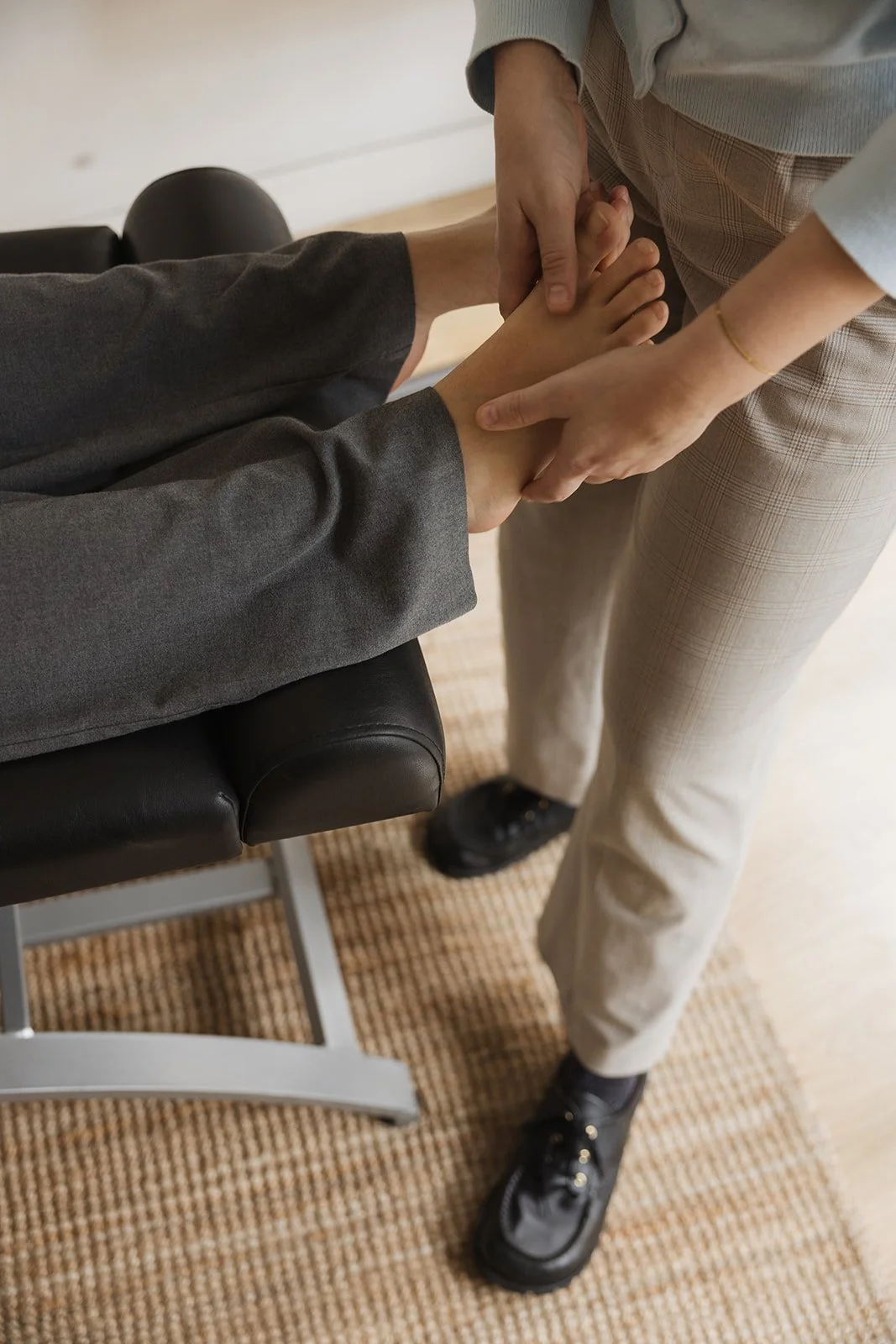
A postural assessment during a barefoot transition can be genuinely useful. Changes in footwear affect the entire kinetic chain above.
First, a nuance worth knowing
Before we get into the rules, something important: the wide toe box is the feature that benefits almost everyone. That part is not controversial.
The zero drop (completely flat sole) is a different story. It is genuinely debated, even among barefoot advocates. Some people thrive on complete zero drop. Others, especially those with certain foot structures or active conditions, may do better with a very minimal heel, or with zero drop shoes that have slightly more cushioning. There is no single answer for every foot.
What this means in practice: don't feel like you're "failing" at barefoot if you need a 4mm drop or a gel insole. You're just meeting your body where it is right now.
Why the transition matters so much
Think about what happens when someone starts going to the gym after years of inactivity. If they try to lift heavy on day one, something will likely go wrong. Not because lifting is dangerous, but because the tissues aren't conditioned yet.
The same logic applies here. Years of raised heels have shortened your calf muscles and Achilles tendons. Years of rigid soles have weakened the small intrinsic muscles of the foot. Years of cushioning have reduced the sensory feedback your nervous system is used to processing.
Barefoot shoes ask all of these structures to work differently and more. They need time to adapt.
⚠️ The most common transition injuries: plantar fasciitis flare-ups, Achilles tendinopathy, and metatarsal stress reactions. All are preventable with a gradual approach. None are inevitable. But all are significantly more likely when the transition is rushed.
The golden rules of transition
Rule 1: Start with one to two hours a day ⏱
Even if the shoes feel comfortable immediately, limit your first week to one or two hours of wear per day. Your feet will feel fine in the moment. The soreness comes the next morning. Start there and build up gradually over weeks, not days.
Rule 2: Start with walking, not running 🚶
Walking is the foundation. Get completely comfortable walking in barefoot shoes before you even think about running. This could take weeks or months depending on your starting point. Running in barefoot shoes requires months of preparation and ideally a physiotherapist or running coach to assess your gait and build a personalised plan. More on this below.
Rule 3: Do the foot exercises every day 💪
This is non-negotiable. The shoes alone are not enough. Your feet need to rebuild strength and mobility in parallel. See the exercise section below. Without this, you're asking already weakened structures to take on more load without building the capacity to handle it.
Rule 4: Walk on varied surfaces
Grass, gravel, sand, and uneven ground are your best friends during transition. They activate the small muscles of the foot in ways that flat pavement doesn't. Walk barefoot on grass whenever you can. Even 10 minutes a day makes a real difference.
Rule 5: Understand soreness vs pain
Mild muscle soreness in the arch, calf, or foot after wearing barefoot shoes is normal, like muscle soreness after a workout. Sharp pain, heel pain that lingers, or pain during activity is a signal to slow down and reassess.
Rule 6: Don't rush zero drop
If you're coming from shoes with a significant heel, consider starting with a 4mm drop and spending several weeks there before going to zero. Alternating between your old shoes and your new barefoot shoes during the transition is a smart strategy, not a failure.
The exercises that make the transition work 🏋️
Do these daily. They are the difference between a smooth transition and an injury. Start gently and build up over weeks.
Toe spreading
Sit or stand, and try to spread all five toes as wide as possible. Hold for 5 seconds, release. Repeat 10 times. Sounds simple, is surprisingly hard at first. This is your most important daily exercise.
Big toe propulsion
Stand barefoot and press your big toe firmly into the ground while keeping the other toes relaxed. Hold for 3 seconds, release. This strengthens the first ray, which is essential for proper push-off mechanics and takes enormous load during every step.
Short foot exercise
Stand barefoot. Without curling your toes, try to shorten the length of your foot by contracting the arch. This activates the intrinsic foot muscles. Hold for 5 seconds, repeat 10 times per foot.
Eccentric calf lowering
Stand on the edge of a step, rise on your toes, then lower slowly over 3 to 4 seconds below the step level. This progressively loads the Achilles and calf. Start with both feet, bodyweight only. Build up over weeks. This is the single most important exercise for Achilles adaptation.
Single leg hopping 🦘
Once your feet are feeling stronger (typically after 4 to 6 weeks of the other exercises), introduce single leg hops. Start with small, gentle hops on the spot, landing softly. 3 sets of 10 per foot. This builds the reactive strength and tendon resilience needed for more dynamic movement.
Ankle circles
20 circles each direction, each foot, every day. Simple mobility work that keeps the ankle joint moving well through the transition.
Toe spacer sessions
Wear toe spacers for 20 to 30 minutes per day. They passively help realign the toes and complement the active work above.

Foot strengthening exercises are not optional during a barefoot transition. They're what makes it work safely.
A note on running 🏃
Running in barefoot shoes is a completely separate conversation from walking. It involves a fundamental change in foot strike (from heel striking to midfoot striking), and the load on the Achilles, calf, and metatarsals is significantly higher than walking.
⚠️ Do not attempt to transition to barefoot running on your own. It will take months of preparation before your feet and tendons are ready. I strongly recommend working with a physiotherapist who can assess your specific foot structure and gait, and build a personalised strengthening and transition plan before you run a single kilometre in barefoot shoes.
Rushing the running transition is the most common cause of serious foot and Achilles injuries I see in active patients who have switched to barefoot footwear.
What to do if something hurts
If you develop heel pain, sharp arch pain, or Achilles discomfort that doesn't resolve with rest within a few days: stop pushing through it. Go back to less barefoot exposure, continue the exercises gently, and if it persists, see a physiotherapist.
Pushing through pain during transition is the fastest way to turn a minor adaptation soreness into an actual injury that sets you back months. Your feet are worth the patience.
Frequently asked questions
Is it normal to have pain when transitioning to barefoot shoes?
Mild soreness in the arch, calf, or foot is normal and expected, like muscle soreness after starting a new workout. It's one of the most common questions I receive on Instagram. The key distinction: soreness that fades within a day or two is adaptation. Pain that lingers, sharpens during activity, or affects your gait is a signal to slow down and get assessed.
How long does a full transition take?
Anywhere from 3 months to over a year, depending on your history with conventional shoes, your current foot strength, and how gradually you approach it. There is no universal timeline. Go at the pace your body dictates.
Can I speed up the transition?
Not without increasing injury risk. The limiting factor is tissue adaptation, which takes the time it takes. What you can do is maximise quality by doing the exercises daily and getting varied surface exposure.
My calves are very sore after a week. Is that normal?
Yes. Your calf muscles and Achilles are being asked to work through a fuller range of motion than they're used to. Reduce daily wear slightly, keep up the calf stretching and eccentric loading, and the soreness should reduce within one to two weeks.
Should I see a chiropractor during my barefoot transition?
A postural and spinal assessment during a barefoot transition can be genuinely useful. Changes in footwear affect the entire kinetic chain from the feet upward, and having a clear picture of where compensations exist helps you understand what you're feeling and why. You can read more about what that assessment involves in my post on your first chiropractic appointment.
📖 My full guide on barefoot shoes, exercises, and brand recommendations is available in French. If you read French, you can find it here: Bien Bouger Commence par les Pieds → 🇫🇷
The transition is the hardest part. It's also where the real change happens. Be patient with your feet. They've been waiting a long time for this. 💙
Want a full postural assessment as you transition? Book a first consultation in Barcelona.
Book your first consultation →Lea Salgado, Chiropractor · Barcelona · leaquiropractica.com