Your feet, your posture, your spine: why it all starts from the ground up
📚 This is Part 1 of the Barefoot Series
- Part 1: Your feet, your posture, your spine (this article)
- Part 2: How to choose barefoot shoes (coming soon)
- Part 3: How to transition safely (coming soon)
- Part 4: Barefoot and specific conditions (coming soon)
In 2019, I was dealing with double plantar fasciitis. Three different podiatrists, electrostimulation sessions, orthotics... and the pain never fully went away. I had become dependent on custom insoles just to walk without discomfort.
On top of that, I started noticing my big toe slowly drifting. The beginning of a hallux valgus.
That's when I discovered the world of barefoot shoes. And it changed everything, not just for my feet, but for how I understand the whole body.
As a chiropractor, I analyse posture every day. And what I see again and again is this: posture doesn't just affect your back. It affects everything downstream. Including your feet. 👣
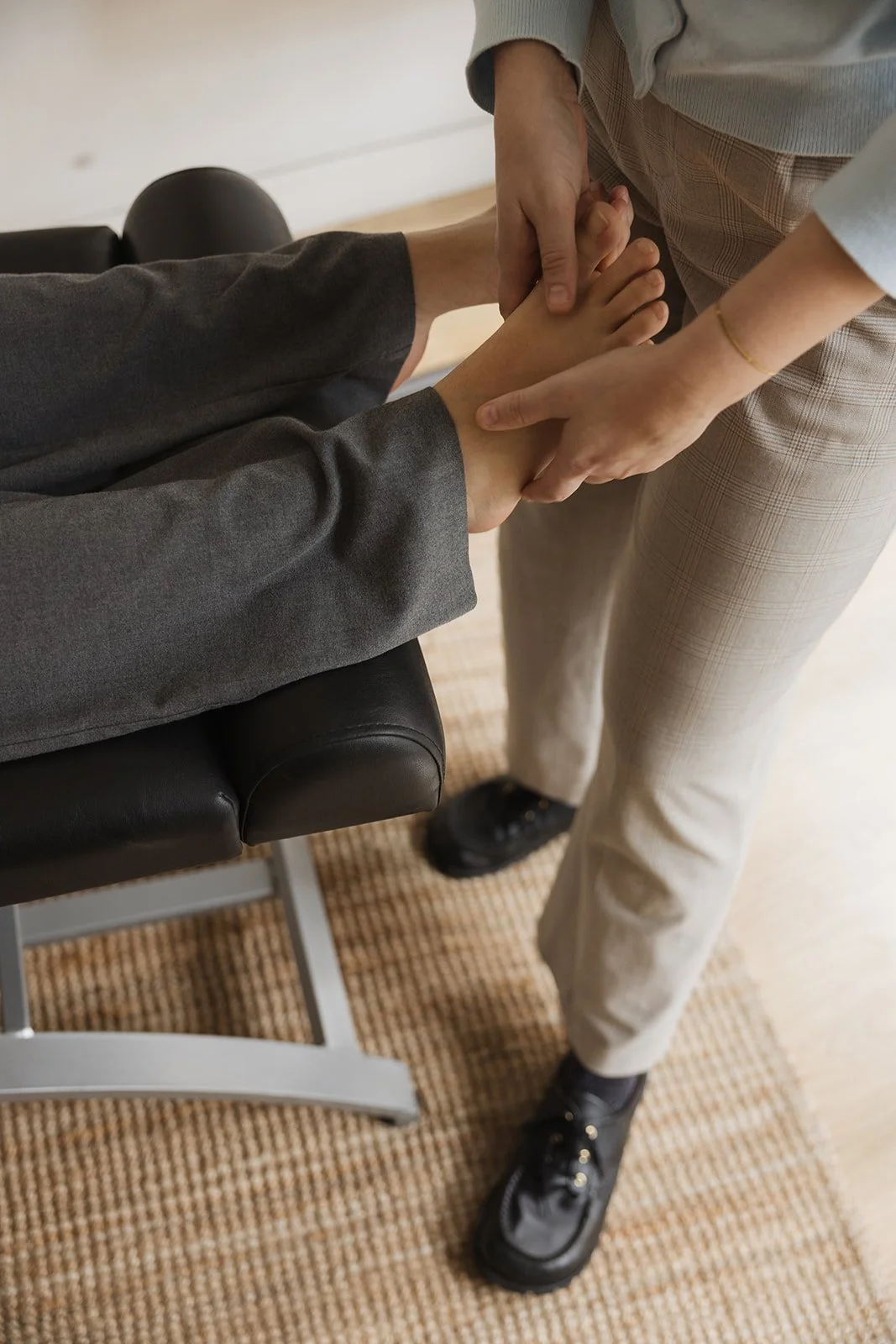
Foot assessment is part of the full postural picture. What happens at ground level matters for the whole chain above.
Posture impacts everything from hips to heels 🔗
Most people think of posture as a "back problem." But posture is a full-body pattern. The way you hold your head affects your shoulders. Your shoulders affect your thoracic spine. Your thoracic spine affects your lumbar curve. Your lumbar curve affects your pelvis. Your pelvis affects your hips. And your hips affect how your legs and feet land on the ground.
This is what we call the kinetic chain. A misalignment or restriction at any point creates compensations up and down the chain. And those compensations accumulate quietly over time, before they become painful.
Head and neck
Forward head posture increases load on the cervical spine and upper back
Spine and pelvis
Pelvic tilt changes the lumbar curve and affects how load is distributed through the hips
Hips, knees and feet
Hip imbalance changes how force travels through the knee and lands on the foot with every step
What barefoot footwear does is allow the feet to function as they were designed to, without artificial restriction, so the whole chain above has a better foundation to work from.
The conditions that often trace back to the feet
In practice, I regularly see patients who come in for one thing and discover that their footwear has been contributing to a pattern they didn't connect to their shoes at all.
Plantar fasciitis 🦶
One of the most common foot complaints I see. The plantar fascia is the band of tissue running along the bottom of the foot. When it is under sustained tension, often from a combination of tight footwear, reduced foot mobility, and poor load distribution up the chain, it can become irritated and painful. Conventional shoes with narrow toe boxes and rigid soles may contribute to this pattern by limiting the foot's natural movement and sensory input.
Achilles tendon issues and calcaneal spurs
The Achilles tendon connects the calf muscles to the heel bone. A raised heel in conventional shoes keeps the calf in a shortened position all day. Over time, this can increase tension on the tendon and contribute to heel discomfort. Calcaneal spurs (bony growths at the heel) are often associated with the same pattern of chronic tension and restricted foot movement. Transitioning to zero-drop footwear, done progressively, may help reduce that chronic load over time.
Hip tension and imbalance
This one surprises people. When the foot is restricted and can't pronate or supinate naturally, the ankle, knee, and hip compensate with every single step. A foot that consistently rolls inward or outward changes the rotation pattern of the entire leg, which feeds directly into hip loading. I regularly see patients with chronic hip tension whose footwear is a significant part of the picture.
Hallux valgus
A lot of people believe hallux valgus is purely genetic. Research increasingly suggests that footwear plays a significant role in its development. Shoes with a wide toe box allow the toes to stay aligned rather than being compressed inward. Combined with toe spacers and specific strengthening exercises, many people notice a reduction in discomfort and gradual improvement over time. That said, if the deformity is already well established, full reversal may not be possible. Early awareness matters. I know this from my own experience. 🙃
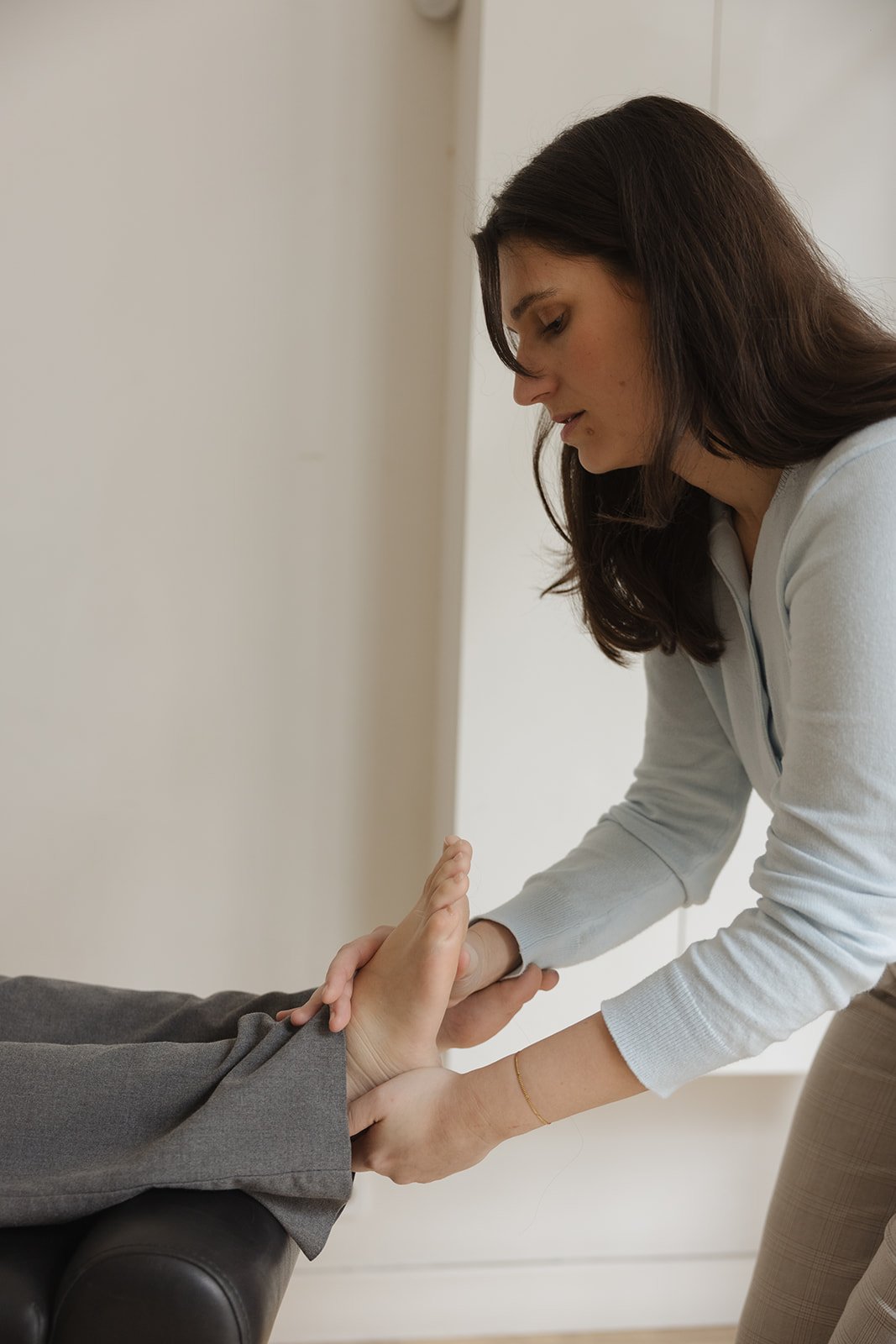
The foot, ankle, knee, and hip all communicate. A restriction anywhere in that chain tends to show up somewhere else.
What conventional shoes may be doing
Most conventional shoes share a few characteristics that may work against your foot's natural function:
- A narrow toe box that squeezes the toes together
- A raised heel that shifts your centre of gravity forward, modifies your lumbar curve, and keeps your calf muscles in a chronically shortened position
- Thick cushioning that reduces sensory input from the ground
- A rigid sole that prevents the small muscles of the foot from activating
If your foot is wrapped in a rigid, cushioned, elevated structure all day, the muscles, ligaments, and joints inside it rarely have to work. Over time, they may weaken. The arch loses its active support. The toes lose their natural spread. And the rest of the body adapts around a foundation that isn't functioning as it should.

A raised heel, narrow toe box, and rigid sole: three features of most conventional shoes that may affect the whole kinetic chain above.
What barefoot shoes actually are
Barefoot shoes are designed to be as close to walking barefoot as possible, because walking barefoot in a city simply isn't practical. They share a few key characteristics:
- A wide toe box that lets the toes spread fully
- Zero drop (no height difference between heel and toe)
- A thin, flexible sole that allows sensory feedback from the ground
- Lightweight construction that doesn't restrict movement
⚠️ Important warning on transition: If you've been wearing conventional shoes your whole life, your feet, calves, and Achilles tendons have adapted to that environment. Transitioning too quickly to zero-drop barefoot footwear can overload unprepared tissues particularly the Achilles and plantar fascia and cause injury. A progressive transition is not optional, it's essential. I'll cover this in detail in Part 3 of this series.
The proprioception connection 🧠
Your foot contains 26 bones, 33 joints, and over 100 muscles, tendons, and ligaments. It also has one of the highest concentrations of proprioceptive receptors in the entire body. When those receptors are stimulated correctly, they send rich information to the brain and spinal cord about balance, position, and movement.
When that input is reduced by thick soles and rigid shoes, the nervous system has to work harder to coordinate movement. The spine may compensate. Muscles tighten in areas that shouldn't be tight. Joints may take load they weren't designed for.
This is why in my practice, I regularly ask patients about their footwear. It connects directly to everything I wrote about in my post on why active people in Barcelona see a chiropractor.
A simple starting point 🙌
- Walk barefoot at home as much as possible. Grass and sand are even better.
- Start wearing toe spacers for 20 minutes a day to begin repositioning the toes.
- Look for shoes with a wide toe box, even if they're not fully barefoot. That single change makes a meaningful difference.
- Do foot mobility exercises daily: toe spreading, arch lifts, calf stretches, ankle circles.
📖 I have put together a full guide on barefoot shoes, exercises, and transition tips. It is currently available in French only. If you read French, you can find it here: Bien Bouger Commence par les Pieds → 🇫🇷
Frequently asked questions
Can I wear barefoot shoes if I have flat feet?
Orthotics and arch support prop up the arch passively but may prevent the small muscles from learning to support it actively. Flat feet are often a functional issue rather than a purely structural one. A gradual transition to more minimal footwear, combined with strengthening exercises, may support better foot function over time. If you have pain or specific concerns, get a professional assessment first.
What about plantar fasciitis or Achilles issues?
More minimal footwear may help by allowing the foot to move more freely and reducing chronic tension on these structures. However, footwear alone is rarely sufficient. Specific exercises and professional support are usually needed as well. And the transition needs to be done very progressively to avoid making things worse.
My hip pain started before my foot issues. Could they be connected?
Possibly, yes. The kinetic chain runs in both directions. Hip restrictions can change how the foot loads the ground, and foot restrictions can feed into hip tension over time. A full postural assessment looks at the whole picture rather than just the area where the pain is showing up.
Is barefoot footwear suitable for children?
Yes. A rigid shoe may prevent the foot from developing its natural musculature. Children's feet benefit from freedom of movement at every stage of development.
Can I run in barefoot shoes?
Running in barefoot shoes requires significant adaptation, especially if you're used to maximalist running shoes. I strongly recommend working with a physiotherapist or running coach who can build a personalised plan for your specific gait and history before making the switch.
How does this connect to chiropractic care?
Footwear is one piece of the postural picture. If the feet are functioning better, the whole kinetic chain above benefits. But existing spinal or neurological restrictions need to be assessed separately. You can read more about the signs your body is asking for help in this article.
Your feet are your foundation. Give them the space to do their job. 💙
Want to understand how your posture and spinal function connect? Book a first assessment in Barcelona.
Book your first consultation →Lea Salgado, Chiropractor · Barcelona · leaquiropractica.com