Retained primitive reflexes in kids: signs, ages and what to look for
I jump at every unexpected noise. Bright light genuinely bothers me. A door slams somewhere in the building and my whole body reacts before my brain has caught up.
For years I thought that was just my personality. Then I trained in paediatric chiropractic and learned about primitive reflexes, and something clicked: my Moro reflex, the one we are all born with and that should fade in the first months of life, never fully integrated.
What primitive reflexes are
We are all born with a set of automatic movement patterns. A newborn does not decide to grip your finger or turn their head towards a touch on the cheek. It happens on its own, driven by the most primitive part of the nervous system.
These reflexes help with birth, with feeding, with the first months of life before the brain can take over consciously. Then they should fade, as higher parts of the brain mature and take control. We call this integration, and it happens largely through movement: tummy time, rolling, crawling, all the messy floor exploration of the first year.
Sometimes that process is incomplete. The reflex stays partially active in the background, and the nervous system keeps running an old programme alongside the newer ones. Think of it as an app that never closed. Everything still works, but there is a constant small drain, and under load it shows.
Integration happens largely through movement in the first year of life. Floor time is not just play.
The reflexes I look at, and when they should be integrated
The ages below are general guidelines, not deadlines. What follows is what the literature associates with incomplete integration, not a diagnosis. Plenty of children show one of these signs for entirely different reasons.
Moro, the startle reflex
Usually integrated around 4 to 6 months
Associated with heightened sensitivity to noise, light or sudden change, difficulty settling, and a nervous system that sits closer to alert than to rest. This is mine, so I have a certain sympathy for it.
Rooting
Usually integrated around 4 months
The reflex that turns a baby's head towards a touch near the mouth. Associated with oral habits and, in infancy, with the mechanics of feeding.
Palmar
Usually integrated around 5 to 6 months
The grip reflex. Associated with hand tension and with pencil grip later on.
ATNR, asymmetrical tonic neck reflex
Usually integrated around 6 months
When the head turns, the arm on that side extends. Associated with difficulty crossing the midline of the body, and with handwriting that feels harder than it should.
Spinal Galant
Usually integrated between 3 and 9 months
A touch along one side of the lower back produces a movement of the hip. Associated with constant fidgeting, real discomfort with waistbands or labels, and difficulty sitting still.
Perez
Usually integrated around 3 to 6 months
Another spinal reflex, closely related to Spinal Galant. Worth checking when that one does not settle.
STNR, symmetrical tonic neck reflex
Appears around 6 to 9 months, integrated around 9 to 11 months
Links head position to arm and leg tone. Associated with slumping at a desk, W sitting, and difficulty holding an upright position.
Babinski
Usually integrated between 12 and 24 months
A stroke along the sole of the foot produces an extension of the big toe. Associated with sensitivity of the feet and with how weight is distributed when walking.
TLR, tonic labyrinthine reflex
Integrates gradually, usually complete by around 3 years
Linked to head position and gravity. Associated with balance, coordination and the sense of the body in space.
From around three years old, the expectation is that all of these are integrated, meaning no response at all. So at that age I am simply looking at whether anything is still showing up, and how strongly.
This is not only a children's topic
A while ago I was assessing an adult in his late twenties. Standard first visit, standard spinal palpation, nothing unusual about how I was working.
As I worked along his lower back, his body produced a clear, involuntary response on one side. A textbook Spinal Galant pattern, in a 29 year old.
He was not surprised. He told me it had always been like that, and that it had been a quiet source of embarrassment in his personal life. He had never mentioned it to anyone, because he had no idea it was a thing that had a name.
We worked on it as part of his care, with adjustments and with exercises at home. Over the following months he told me the response had faded considerably. I cannot promise anyone the same outcome, and I would not try to. But I think about that conversation often, because of how long he had carried something without knowing it could even be looked at.
Reflexes can be assessed at any age. It tends to be simpler in children, because the nervous system is still highly adaptable and the exercises are easy to turn into play. But adults are absolutely not a lost cause.
What an assessment looks like
This is the part that reassures parents most, so let me be clear about it.
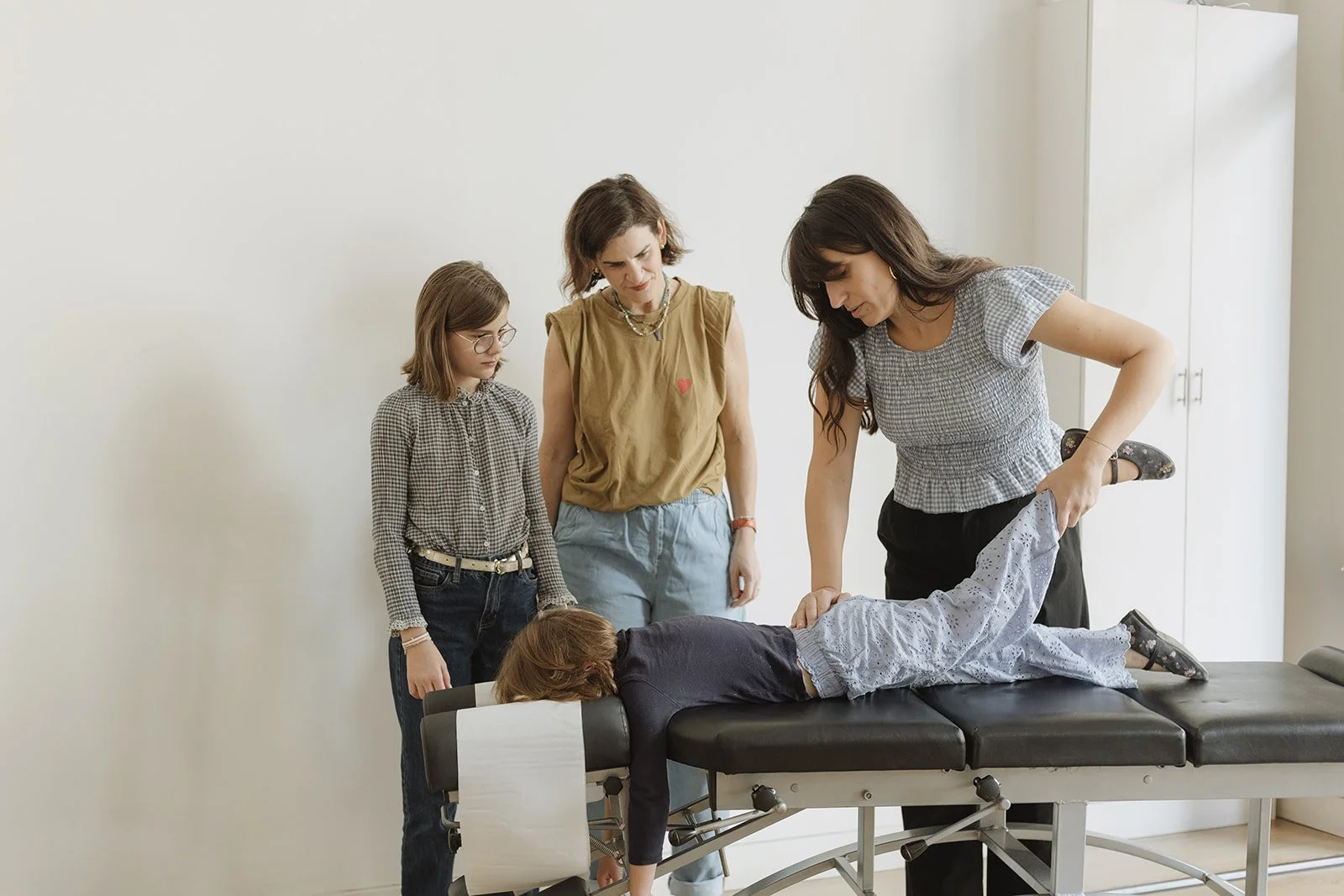
Testing a reflex means asking for a specific movement, or gently changing the position of the head, and observing how the body responds. That is it. Nothing invasive, nothing uncomfortable, and it does not hurt. Most children find it a slightly odd game.
I note whether the response is present, how strong it is, and whether it differs between left and right, so we have something to compare against later.

Assessment is gentle, quick and completely painless.
What we do next
Two things, side by side. The chiropractic side is my work on the spine, supporting how the nervous system organises and communicates. The home side is one specific exercise, done daily for a month, and this is where most of the change is built.
For children, that exercise becomes a game. The names give you the tone: the starfish, the superman, the lizard, snow angels, cat and cow, the inchworm. Nobody is doing therapy on the living room floor. You are doing something silly together after brushing teeth. After a month, we retest and look at what has moved.
One rule I follow: if more than one reflex is showing up, we start with a single one rather than working on everything at once. Doing one thing properly beats doing four things vaguely, and it keeps the whole thing manageable for the family.
Where my training comes from
I trained in paediatric and perinatal care with the ICPA, the International Chiropractic Pediatric Association, on top of my chiropractic degree from the Barcelona College of Chiropractic.
Working with children is not the same as working with adults. The techniques are different, the pressure is different, and what you look for is different. That is why the additional training matters, and why I am proud of this part of my practice. More on my Families page.
Frequently asked questions
Does testing reflexes hurt?
No. It involves light touch and simple movements. Most children experience it as a game.
At what age can this be assessed?
At any age, including babies. The assessment is simply adapted to what the child can do.
My child has one of these signs. Does that mean a reflex is not integrated?
Not necessarily. Fidgeting, messy handwriting or trouble sitting still have many possible explanations. A reflex is one thing to look at among others, never a conclusion on its own.
How long does it take?
The home exercise usually runs over a month before we retest. What happens after that depends on what we find.
Is it too late for adults?
No. It tends to be quicker in children because the nervous system is more adaptable, but adults can absolutely work on this too.
Most of what I do comes back to the same question: how well is this nervous system able to organise itself right now. Primitive reflexes are one of the clearest windows into that, at any age. 💙
Curious about a reflex and postural assessment for your child in Barcelona?
Book a consultation →Lea Salgado, Chiropractor · Barcelona · leaquiropractica.com