Chiropractic care during pregnancy: what you need to know
Pregnancy changes everything about how your body moves, distributes weight, and holds itself together. And for a lot of pregnant people, it also means months of discomfort that gets quietly accepted as "part of the deal."
It doesn't have to be. 😊
Chiropractic care during pregnancy is one of the most underused options I know of for supporting comfort and function throughout all three trimesters. And yet it's one of my favourite things to work with in practice.
Let me explain what it actually involves, what the research says, and what to expect if you're considering it.
Why pregnancy changes your spine and pelvis 🤰
The physical changes of pregnancy are significant, and they happen fast. As the belly grows, the centre of gravity shifts forward. The lumbar curve increases. The pelvis widens and the ligaments soften due to the hormone relaxin, which prepares the body for birth but also affects joint stability throughout the body.
Add to this the postural adaptations that come with carrying extra weight, changes in sleep position, reduced core support, and the demands of daily life, and you have significant mechanical changes to the spine and pelvis.
Lower back discomfort, pelvic girdle pain, round ligament tension, and sciatic-type symptoms during pregnancy are not inevitable. They are often associated with mechanical changes that can be assessed and supported. 🙏
What chiropractic care during pregnancy actually involves
The approach I use during pregnancy is adapted completely to the stage of pregnancy and the individual. There are no techniques that put pressure on the belly. Positions are modified throughout, and from the second trimester onwards I use specific pregnancy pillows and adapted table positions so you can lie comfortably.
The focus is on:
Pelvic alignment 🦴
The pelvis plays a central role in both pregnancy comfort and birth preparation. When the pelvis has mechanical imbalance or the surrounding ligaments are under uneven tension, this can affect comfort during pregnancy. I assess and work to support better pelvic function throughout.
Spinal function 🧠
The nervous system coordinates much of what happens in your body during pregnancy. Supporting spinal function may have a positive effect on how your nervous system manages the demands of this period. You can read more about this connection in my post on how to support your nervous system at home.
Soft tissue work 🤲
Alongside adjustments, I work on the ligaments and muscles that are under the most stress during each trimester.
What does the research say? 🔬
The research on chiropractic care during pregnancy is encouraging. A systematic review found that chiropractic care, including spinal manipulation and soft tissue therapy, was associated with reductions in low back and pelvic discomfort during pregnancy, with no serious adverse events reported.
The Webster Technique, a specific chiropractic protocol used during pregnancy, has been studied in relation to pelvic balance. While research in this area is still developing, the technique is widely used and has a good safety record among prenatal chiropractors.
Chiropractic during pregnancy is supportive care. It is not a medical intervention and does not replace obstetric care. I work alongside your midwife or gynaecologist, not instead of them.
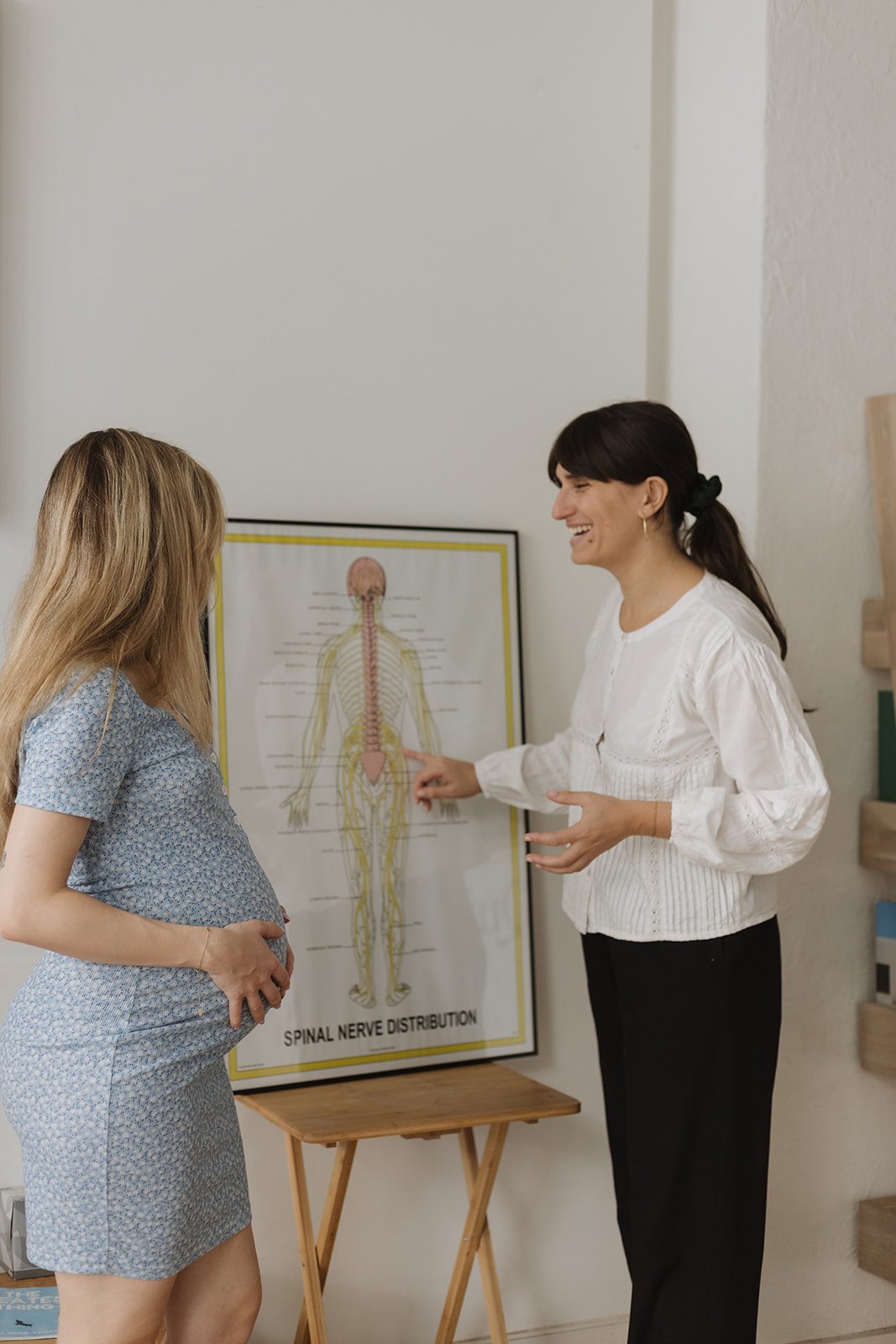
All techniques used during pregnancy are adapted to the stage and individual. No pressure on the belly, ever.
Is it safe? ✅
Chiropractic care during pregnancy, when performed by a chiropractor trained in prenatal techniques and in the absence of contraindications, is considered safe throughout all three trimesters. The adjustments used are gentle, specific, and adapted to the stage of pregnancy.
As with any care during pregnancy, I take a thorough history at the first visit and check for any contraindications before proceeding. There are situations where chiropractic is not appropriate, and I will always be honest with you if that is the case.
When is a good time to start? 📅
Honestly, any trimester.
- First trimester: before discomfort sets in, as a way of supporting the body through the significant changes ahead.
- Second trimester: when lower back or pelvic discomfort starts to appear and daily comfort becomes a priority.
- Third trimester: to support pelvic function and prepare the body for birth.
There is no single "right" time. The right time is when you feel you'd benefit from support.
Postpartum care is also something I work with regularly. The body goes through significant changes after birth too, particularly if you are breastfeeding, carrying a baby, or recovering from a caesarean. Many of my pregnancy patients continue care after birth, both for themselves and for their newborn. 👶
If you'd like to understand more about what a first visit looks like, I wrote a full guide on what actually happens at your first chiropractic appointment.
And if you're wondering whether your discomfort is worth getting assessed, these 7 signs your body is asking for help might give you some clarity. 🙌

Pregnancy is a lot. Your body is doing something extraordinary. Supporting it well during this time makes sense.
Frequently asked questions
Is chiropractic safe during the first trimester?
Adjustments during the first trimester are gentle and do not involve any pressure on the abdomen. I take a thorough history to check for any contraindications before we start.
Can chiropractic help with pelvic girdle pain during pregnancy?
Pelvic girdle pain is one of the most common reasons pregnant patients come to see me. The research supports chiropractic as a safe option for managing this type of musculoskeletal discomfort during pregnancy. Results vary individually.
Will I need to lie on my stomach?
No. I use specific pregnancy pillows and adapted positions so you can be comfortable at every stage of pregnancy. Nothing puts pressure on your belly.
How often should I come during pregnancy?
This varies depending on where you are in your pregnancy and what I find at assessment. I'll give you an honest recommendation after the first visit. There is no one-size-fits-all protocol.
Can my newborn see a chiropractor?
Yes. Paediatric chiropractic uses very gentle techniques adapted to newborns and infants. More info on my Families page.
Do I need a referral from my midwife or gynaecologist?
No referral is needed. You can book directly. If you'd like me to communicate with your obstetric team, I'm happy to do that.
What is the difference between a chiropractor and an osteopath during pregnancy?
Both can work with pregnant patients, but the focus is different. As a chiropractor, I specialise in spinal and nervous system function with specific prenatal protocols. I broke down the full difference in my post on the difference between chiro, osteo, and physio.
Pregnancy is a lot. Your body is doing something extraordinary. Supporting it well during this time is not a luxury. It's just good sense. 💙
Pregnant and wondering if chiropractic could help? Book a first assessment in Barcelona and let's find out together.
Book your first consultation →Lea Salgado, Chiropractor · Barcelona · leaquiropractica.com